
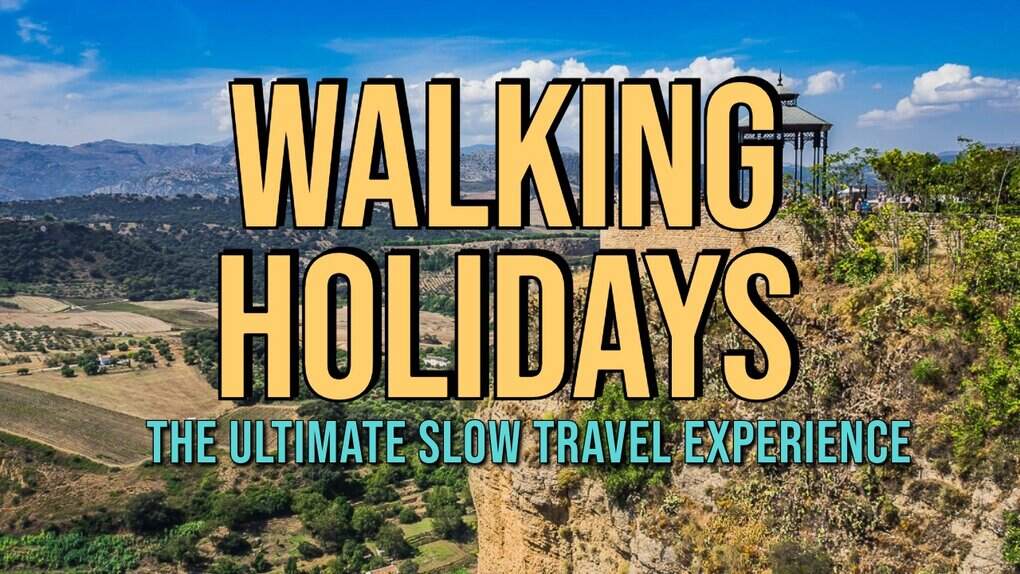

Walking holidays or simply travelling more on foot changed the way I experience a place. They gave me space to notice small details, to let days unfold rather than chasing them.
Modern travel often mirrors modern life — busy, over-planned, and constantly nudging us toward the next thing. Even when we’re already somewhere beautiful, there’s an urge to check directions, take photos, or rush to the next café because it’s on the list.
I’ve travelled that way plenty of times. City breaks packed with highlights, full itineraries, attractions queued and photographed, evenings ending with tired feet and the feeling that I’d seen a lot but absorbed very little. It wasn’t until I started slowing my trips down, quite literally, by walking.
They were the slower ones, especially the trips where walking was the main way of getting around. Travel began to feel different again.
Read More: The Most Beautiful Walking Holiday Routes Around Europe
The psychology of slow travel
There’s something grounding about the rhythm of walking. When you walk for hours, your mind settles into a steadier pace. You stop scanning for what’s next and start noticing what’s around you.
There is a deep connection between the rhythm of footsteps and the state of our minds. Slow travel isn’t about doing less for the sake of it. It’s about experiencing places more deeply. When walking long distances, our brains move from high-alert beta waves to more relaxed alpha waves.
When you walk, the pace of travel naturally shifts. You’re no longer jumping between transport stops or rushing to “fit things in”. Instead, you move through a place gradually — neighbourhood by neighbourhood, village by village.
I’ve felt this shift happen somewhere between the first few kilometres and the first coffee stop of the day. Thoughts that felt loud before gradually quieten. Decisions become simpler: where to stop, when to eat, how far feels comfortable today.
This kind of mental rest is very different from lying on a beach. I love a beach day as much as anyone, but I’ve noticed how easy it is to stay mentally restless — scrolling, checking messages, half-relaxing. Walking, on the other hand, gently occupies both body and mind. You’re engaged, but not overwhelmed.
On walking trips, I’ve noticed how much more present I feel. Conversations last longer. Museums feel less overwhelming. Even quiet moments — a coffee stop, a church bench, a viewpoint — become part of the experience rather than something rushed past.
Walking creates space, and that space is often what we’re missing when we travel.
Choosing the right path for your mind
One of the biggest misconceptions about walking holidays is that they’re extreme or require specialist skills. They don’t.
Walking is not hiking. You don’t need to carry camping gear, navigate remote wilderness, or wear technical equipment. Some of the most rewarding walking trips I’ve done involved nothing more than comfortable trainers, a day pack, and a clear route.
There’s a noticeable mental shift that happens after a few hours of steady walking. The constant sense of urgency fades, replaced by a calmer rhythm.
The key is choosing established paths. Well-established historic walking trails across Europe, for example, are designed to be accessible. They pass through towns and villages, connect cafés and bakeries, and are never far from accommodation or transport links.
I’ve walked routes where mornings began with quiet countryside paths and afternoons ended in lively town squares. You get both nature and culture — without the stress of being “off grid”.
Read More: The 7 Most Romantic Honeymoon Destinations in Europe
Finding a definitive goal
Routes with a clear endpoint offer a sense of completion that many modern trips lack. Walking without a plan can be pleasant for an afternoon, but for a multi-day trip, having a defined route makes a real difference.
There were days when my legs were tired, and the weather wasn’t ideal. Knowing where I was heading and why helped me keep going. That sense of progression matters. It turns discomfort into part of the story rather than a reason to stop.
For the proper sense of achievement and closure, you could look for routes that end at a significant geographical landmark or pilgrim destination. There is something very satisfying about a journey to the edge of the world, which is a route that continues past the cities and cathedrals to the cliffs where the land physically ends at the Atlantic Ocean.
That sense of arrival stays with you. It’s not about achievement in a competitive sense — it’s about continuity, effort, and closure.
Removing the logistical stress
Ironically, planning a “relaxing” holiday can be stressful. Accommodation bookings, luggage concerns, route mapping — even experienced travellers can feel weighed down by it all.
On walking trips, I’ve found real value in letting someone else handle the logistics. Agencies like Santiago Ways, for example, arrange accommodation, provide clear routes, and transfer luggage between stops.
That small investment can completely change your mindset. Knowing that your bag will be waiting for you at the end of the day allows you to walk freely. You stop planning ahead and start paying attention to where you are.
For slow travel, that shift makes all the difference.
ABOUT THE AUTHOR
Everything Zany
Travel Blog
Everything Zany Travel Blog exploring the UK and beyond. Sharing travel guides, tips, history, and culture. Our travel media brand is founded by travel and hotel industry expert – Ryazan Tristram, a Dual Citizen (British–Filipina) based in Birmingham, UK. Everything Zany is a reputable and award-winning travel blog. Our work and contributions have been featured in the Huffington Post, CNBC, Discovery Channel, GMA, Readers Digest, and Lonely Planet. Our mission is to build a great travel community and resource of travel tips, visas, and travel guides for travelers. Join us as we travel around the UK and beyond with a mission to share the best of the world.
Please visit:
Our Sponsor