
[]
= 1140 ) { /* large monitors */ var adEl = document.createElement(“ins”); placeAdEl.replaceWith(adEl); adEl.setAttribute(“class”, “adsbygoogle”); adEl.setAttribute(“style”, “display:inline-block;width:728px;height:90px”); adEl.setAttribute(“data-ad-client”, “ca-pub-1854913374426376”); adEl.setAttribute(“data-ad-slot”, “8830185980”); (adsbygoogle = window.adsbygoogle || []).push({}); } });window.addEventListener(“load”, function(){ var placeAdEl = document.getElementById(“td-ad-placeholder”); if ( null !== placeAdEl && td_screen_width >= 1019 && td_screen_width = 768 && td_screen_width < 1019 ) { /* portrait tablets */ var adEl = document.createElement("ins"); placeAdEl.replaceWith(adEl); adEl.setAttribute("class", "adsbygoogle"); adEl.setAttribute("style", "display:inline-block;width:468px;height:60px"); adEl.setAttribute("data-ad-client", "ca-pub-1854913374426376"); adEl.setAttribute("data-ad-slot", "8830185980"); (adsbygoogle = window.adsbygoogle || []).push({}); } });window.addEventListener("load", function(){ var placeAdEl = document.getElementById("td-ad-placeholder"); if ( null !== placeAdEl && td_screen_width
Temples are the home of deities where they live just like we live in our homes, following a set routine throughout the day and celebrating special occasions around the year. Temples are also a form of deity, designed to make us feel their presence at both the gross as well as subtle levels. In the good old days, they were the nerve system that kept society together as a public place that belonged to everyone. Temples and their ecosystem have also evolved as human civilization has evolved. Unique and or Unusual Temples of India are enlisted in this article.
Table of Contents
= 1140 ) { /* large monitors */ var adEl = document.createElement(“ins”); placeAdEl.replaceWith(adEl); adEl.setAttribute(“class”, “adsbygoogle”); adEl.setAttribute(“style”, “display:inline-block;width:360px;height:300px”); adEl.setAttribute(“data-ad-client”, “ca-pub-1854913374426376”); adEl.setAttribute(“data-ad-slot”, “7048430498”); (adsbygoogle = window.adsbygoogle || []).push({}); } });window.addEventListener(“load”, function(){ var placeAdEl = document.getElementById(“td-ad-placeholder”); if ( null !== placeAdEl && td_screen_width >= 1019 && td_screen_width = 768 && td_screen_width < 1019 ) { /* portrait tablets */ var adEl = document.createElement("ins"); placeAdEl.replaceWith(adEl); adEl.setAttribute("class", "adsbygoogle"); adEl.setAttribute("style", "display:inline-block;width:336px;height:280px"); adEl.setAttribute("data-ad-client", "ca-pub-1854913374426376"); adEl.setAttribute("data-ad-slot", "7048430498"); (adsbygoogle = window.adsbygoogle || []).push({}); } });window.addEventListener("load", function(){ var placeAdEl = document.getElementById("td-ad-placeholder"); if ( null !== placeAdEl && td_screen_width
Toggle
Buy Unusual Temples of India E-book
The heart and soul of the temple, though is the relationship between the deity it is home to and the devotees who take care of the deity, worship the deity, and share their everyday joys and sorrows with the deity. We come across magnificent and grand temples in stone in southern parts of India, we get a glimpse of them in the ruins of North India, but sometimes we miss the not-so-usual, simple temples that are scattered around the land of Bharat. Each of them has a story that leaves you in awe and each time for a different reason.
While they surprise you and push the boundaries of what you think is a temple, these temples also tell us how the temple traditions are formed in response to circumstances and situations. They also tell us about the immense faith people have in their deities, to approach them just like a child reaching out to parents or friends to share their best-kept secrets.
Unique and Unusual Temples of India
Come with me for a journey across some of these Unique and Unusual Temples of India across the country.
Visa Giving Chilkur Balaji
Unless you know about the tradition of the temple, the punch card and the pen look like a puzzle to solve. Inside the temple you see everyone doing Parikrama or circumambulations around the tiny temple holding the card and the pen in their hands. It is the process of saying thank you for what this temple deity Chilkur Balaji promises – a guarantee to get a Visa to travel across borders. Yes, a visa to travel to your dream destination for education, for work, or just for leisure.
Chilkur means small and the temple is dedicated to Balaji. Temple’s story talks about how a devotee found the Murti of Balaji here when he could not go for his annual visit to Tirupati Balaji due to ill health. So, to fulfill his wish Balaji made an appearance near him, which later became a temple as we know it today. So, you see, wish fulfillment is at the root of this temple. One is also advised not to close eyes while praying to Balaji, you talk to him eye to eye.
Where Rats Rule – Unusual Temples of India
In Deshnoke village, close to Bikaner in Rajasthan is the famous Karni Mata temple, more popularly known as the Rat Temple. Yes, you see thousands of rats moving around the temple, and they are lovingly called Kaabas. These rats are treated as the progeny of the Karni Mata – the presiding deity of the temple.
 Karni Mata Temple, Deshnoke
Rats get priority over everyone else here. Visitors can not even wear socks inside the temple, they cannot step over any rat or hurt them in any which way. It is their home and you are just a visitor. If by mistake you hurt one, you have to offer one made in silver at the temple.
Karni Mata is the Kuladevi of the Charan community here as well as the royal family of Bikaner. She was an actual woman who lived more than 600 years ago and did some courageous deeds of miraculous proportions that saved the community. Her life has been documented in a museum located opposite the temple that is built in a fort-like manner.
Nyay Devata – God of Justice
In the Kumaon hills of Uttarakhand, surrounded by tall Deodhar trees is the temple of Golu Devta – the presiding deity of this region. As you enter the temple, you are surrounded by thousands of brass bells all around you. Most of them are tied with a red cloth called Chunri. On the walls of the corridor around the main temple, you have piles of judicial stamp papers and handwritten letters hanging on its walls.

Well, this is ‘Nyay Devta’ or the God of Justice, and when people do not get justice in the world of humans, they turn to Golu Devta to lend them justice. People come to him to sort out their disputes and disagreements.
Most importantly devotees seek his guidance in staying on the right path throughout their lives.
World of miniature Shivalingas
Kashi or Varanasi is the spiritual epicenter of India, and if I may say the world. It is the city of Shiva. But, what is fascinating is to find a million miniature Shivalingas at one premise in the city. I am talking about the ancient Jangamwadi Mutt. It belongs to the Veer Shaiva or Lingayat community that primarily comes from the states of Karnataka and Maharashtra. They believe in and worship only Shivalinga and nothing else.
 Shivalingas at Jangamwadi Mutt – Varanasi
Jangamwadi Math has rooms full of miniature Shivalingas, neatly arranged in rows. These Shivalingas are offered by the devotees during the auspicious month of Shravana.
Wherever you stand in the Mutt, you see so many Shivalingas. You start feeling the presence of Shiva around you.
On the Riverbed of Shalmala
When the water levels are low, you can see the boulders on the Shalmala river bed with finely carved Shivalingas and Nandi bulls – the Vahana of Shiva. Everywhere you look, you find Shivalingas which is known as Sahasralinga. Sometimes the Shivalinga is done but the Nandi’s carving has just been marked on the stone. Sometimes even the linga is half finished. When you look at the base of the boulders you realize that they are indeed a part of the river. Some larger boulders have been creatively chiseled to look like a big bull.
 Shivalinga’s carved on rocks in Shalmala river at Sahasralinga, Sirsi
The legend goes that the King of Sonda Swadi Akasappa Nayaka did not have children. He was advised to create 1008 Shivalingas to get children. So, he got every stone available to him carved into a Shivalinga. He was indeed blessed with children. So these can be seen as a mark of wish fulfillment.
Rudra Shiva of Tala
The place is popularly known for the Devrani Jethani temple, which looks beautiful even in its completely ruined state. A 20th CE excavation here revealed an absolutely unique and stunning piece of sculpture. A more than two-meter high Murti in the red sandstone of a deity in the standing posture. What makes it unique though is the fact that it has various body parts carved using all possible animals and serpents.
 Rudra Shiva red sandstone sculpture
In this sculpture, the headgear is a coil of snakes, nose a combination of chameleon and Scorpio, ears as peacocks, eyebrows as frogs, shoulders as crocodiles, fingers like five fanged snakes, humans as breasts, belly as pot, lions on knees. And many more animals or rather living beings in the finer details.
It is locally called Rudra Shiva. That potentially represents the Pasupatinath form of Shiva where he is seen as the protector of Pasus or animals. Rudra Shiva has become the signature sculpture of the state of Chhattisgarh.
Chausath Yogini Temples – Unusual Temples of India
Unique sculptures remind me of the Yogini temples that are more or less lost to us. Thankfully a few of them survive in central and eastern India. Hirapur is home to one of the smaller but relatively better preserved Chausath Yogini Temple dating back to 9th CE. Chausath in Sanskrit and Hindi means sixty-four. These temples are dedicated to the groups of 64 yoginis who serve the Shiva and Shakti.
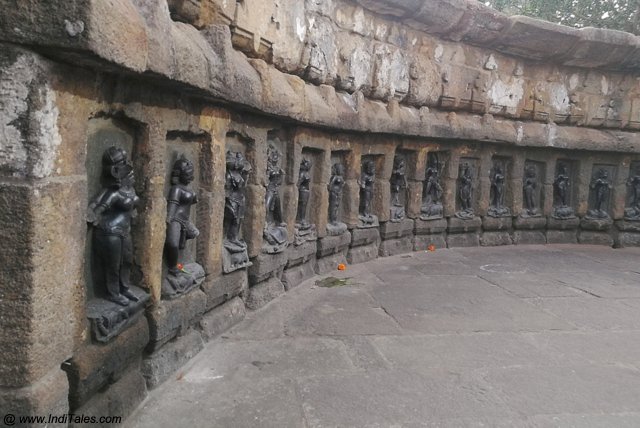 The unique circular shape of Chausath Yogini Temples
What makes yogini temples unique is their circular and open-to-sky architecture. Chausath Yogini temples in contrast are open to the sky with no roof over them, openly interacting with the elements. They are circular in shape with a small opening at one end to enter the temple. Seen from the top, they look like Yoni or the female genitals, a symbol of fertility as well as creation. They also resemble a wheel, called a yogini chakra.
At Hirapur, one sees a Murti of Vinayaki – the Shakti of Vinayaka or Ganesha – a rare sculpture. The chief yogini here, located opposite the temple entrance is Mahamaya, who stands on a human head.
Calming your mental nerves
Literally meaning, the one who enlightens, Devi here lives in her Trigunatamak form. Where all three qualities – Satva, Rajas, and Tamas are embodied in her in one place. There is a fascinating story about how Adi Shankaracharya brought her to Kerala, his land of birth. However, what makes this temple unique is the fact that it is known to cure mental disorders.
Kizhukkavu Temple is a level below the main temple. A special puja called Guruthi Puja performed on Friday evenings is considered particularly beneficial for any mental issues. However, the prescribed worship is for 41 days to get completely cured. People who get cured need to come back and complete the process by putting a nail on the trunks of the tree at the temple premises. They bring a thick nail and hammer it into the tree at the temple with their forehead. Yes, they use their forehead as a hammer to push the nails into the tree trunk.
Becoming Krishna
The village of Marcel in Goa is home to the Devaki Krishna temple. We all know that Devaki gave birth to Krishna in jail in Mathura. He was immediately taken to Gokul village across the river Yamuna. Devaki and Krishna never met during his childhood. The main Murti of the temple here has Devaki holding baby Krishna. The temple celebrates that moment. It is the only temple that is dedicated to the mother-son duo.
They take a bit of oil from the big oil lamp burning inside the temple and put it on their bodies, before getting back to the ground. Now is the time to play in the mud locally called Chikal Kalo. Remember it pours in Goa during monsoons. The ground is naturally muddy. They play various games like Mendrani, blind man’s game, tug of war, kabaddi, and many more before concluding it all with a war of words. What’s interesting is that all these games are believed to be the same games that Krishna played in his childhood in Braj on the banks of Yamuna.
Mummy in Meditation
India is hardly known for having Mummies. But scratch the surface and you would discover a tradition of saints and lamas taking samadhi while meditating and turning themselves into mummies. A few years ago, at Giu, Spiti valley while doing road repair work, a mummy of a Buddhist Lama was accidentally discovered. Lama is sitting in a meditating position. If the local voices are to be believed his name is Sangha Tenzin. He belonged to the Gelugpa order of Buddhism. His nails and hair are still growing, while his teeth continue to be intact.
Radiocarbon dating tells us that he is roughly 550 years old, and was in his early 40s when he died. What is interesting is that no traces of any kind of chemical have been found on his body. Which means a process of natural self-mummification.
Baba Mandir of Nathula
In the eastern Himalayan state of Sikkim, a high mountain pass called Nathula Pass, at a height of more than 12,000 feet is the Baba mandir. It is famous for being a unique temple that is dedicated not to a deity or an ancestor but to an Army man who served the Indian Army in the 1960s.
Sepoy Harbhajan Singh came from a Sikh family in Punjab. He was serving here. On a mission he was leading, he fell into an icy cold river and died. His body could not be located for days. But then he appeared in the dreams of his colleagues and directed them to his body. His bunker was converted into his memorial. It is believed that he continues to perform his duty at the border, by keeping guard at night, and by warning the officers posted there through dreams.
Ode to Bharat Mata – Unusual Temples of India
In Sanatana dharma, the earth has always been treated as a mother. Motherland refers to the land we took birth in, we belong to. Bharat Mata is a deity that came into manifestation during the Indian Independence movement. Abanindranath Tagore, the artist, and nephew of Rabindranath Tagore created the first painting of Bharat Mata in 1905 CE.
 Bharat Mata Mandir – Haridwar
She is depicted wearing a saffron sari with four hands like most goddesses in India are. Her hands hold the essentials of human life – Shiksha-Diksha-Anna-Vastra i.e., education, initiation, food, and clothing.
Learnings from the Unusual Temples of India
These unique temples give us a glimpse of how the legends are formed. They also tell you about the faith that the devotees have in these temples, which is strengthened every time their wishes come true after praying here.
Please visit:
Our Sponsor