
Huayhuash or Santa Cruz — this is the dilemma that grips anyone looking for a multi-day hike in Huaraz. Do you go for the shorter, more comfortable option, or push yourself to hike along the roof of Peru for a week? (Or even opt for a clever compromise between the two?)
I chose to answer this question by completing both hikes.
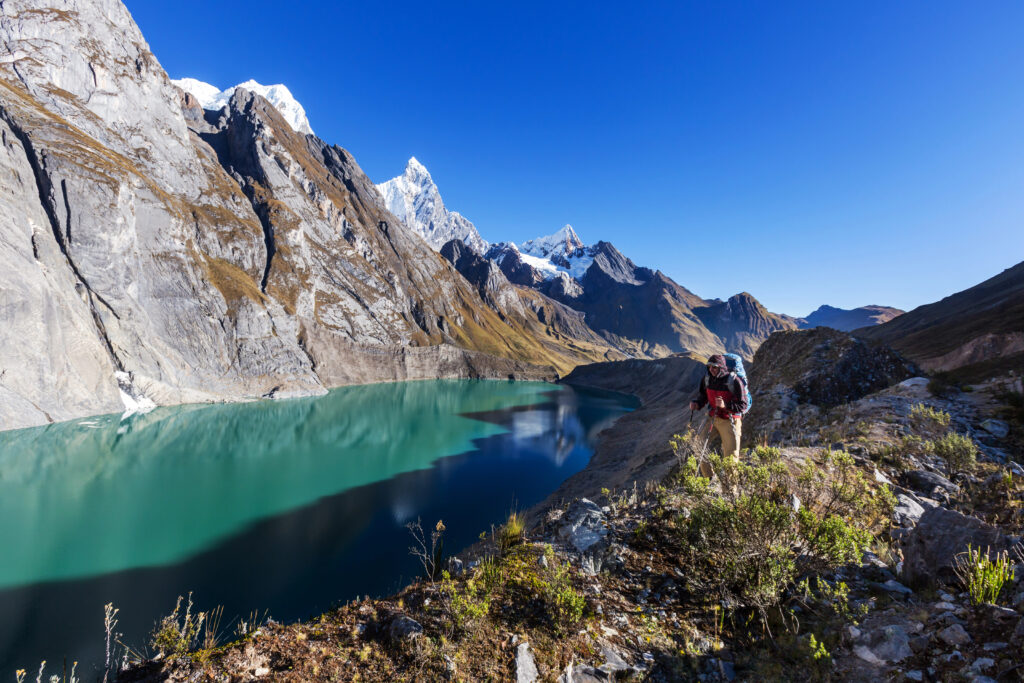
On the tail end of my 6-month South America backpacking trip, I hiked the 4-day Santa Cruz trek, and was entranced by the crisp mountain air, the sunlight dancing on glaciers and the blue brilliance of mountain lakes.
I had wanted to tackle Huayhuash as well, but the iron law of a flight home meant that I had to leave it for another day. This day came a lot sooner than expected. Less than 2 years on, I found myself once again staring up at the Peruvian Andes, this time to do the full 8-day Huayhuash circuit.
In short, my answer to this question is to do both! But fully aware that not everyone can take this approach, I will use my experience to answer this thorniest of dilemmas.
| Criteria | Santa Cruz | Huayhuash |
|---|---|---|
| Length | 51km | 103km (classic 8 day circuit) |
| Days Needed | 3-4 days | 8 days |
| Altitude gain | 2460m | 5240m |
| Average daily walking time | 5 hours 30 minutes | 7 hours |
| How crowded | You will encounter a handful of groups on the trail | You will walk largely in solitude |
| Difficulty | Moderate | Difficult |
| Approx. Price | $200 | $500 |
My personal take on both treks
Santa Cruz
Santa Cruz is easier, more comfortable and is cheaper. Being able to complete an awe-inspiring hike for relatively little money, and not eating into your precious time travelling in South America are golden qualities for the budget or rushed traveller.
For those not feeling the pinch of time or money, you may opt for Santa Cruz anyway, 8 days in the mountains is not easy. Santa Cruz offers the chance for you to marvel at the Andes’ icy grandeur without committing to days of camping at high altitude and walking uphill for more than a week.
The most iconic views of this trek are the Punta Union Pass, the camp at Taullipampa and Lake Arhuaycocha on the third day. In particular, the Punta Union Pass is a true standout that goes toe to toe with anything on Huayhuash.
I was recently challenged to name my top 10 views in the world, and this mountain ridge, where you stand eye level with the eternal winter of Taulliraju’s glaciers, came in the top three, edging out contenders from the Seychelles, Italian Lakes, and Argentina.
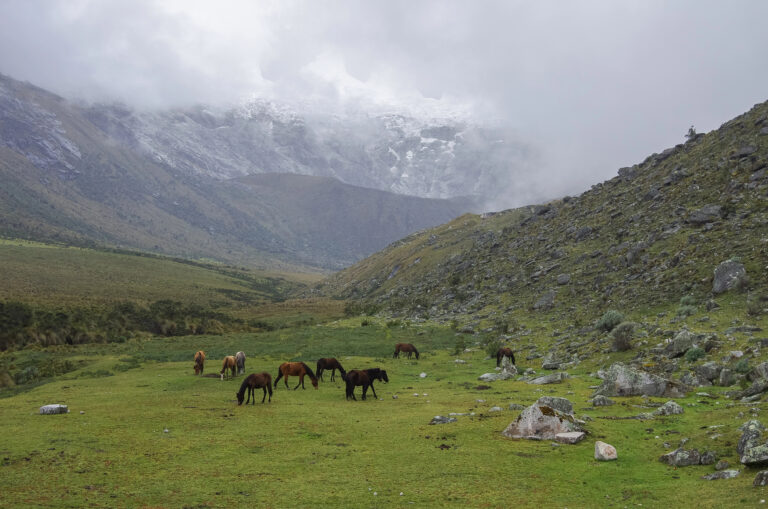 Mountain valley near from Punta Union pass
For me, the drawback of this hike is that you only really walk through the High Andes for a day and a half. For more than half of the trip, the rolling crests of mountains are solely a backdrop. This makes the walking easier, but you sacrifice that intangible sense of being surrounded on all sides by true wilderness. There is a vulnerability you feel in the face of nature on Huayhuash that you don’t get on this hike.
Huayhuash
Huayhuash is a less accessible hike in terms of time, money and physical endurance. It takes twice as much time and money as Santa Cruz, and exerts a much greater physical toll.
This hike will test your limits, both in terms of fitness, and of discomfort. You do not camp any lower than a Spartan 4000m. I once woke up with icicles in my moustache! You also have the smelly prospect of hiking for 5 days without a proper shower.
So why undertake such an ordeal? The first rationale is a star-studded list of views – Las Tres Lagunas of Instagram fame, the San Antonio Pass and the unique situation where each way that you turn on the Yaucha Pass, you are met with scenes that would be worthy of an entire day trip. Each day involves a mountain pass, which guarantees staggering mountain views.
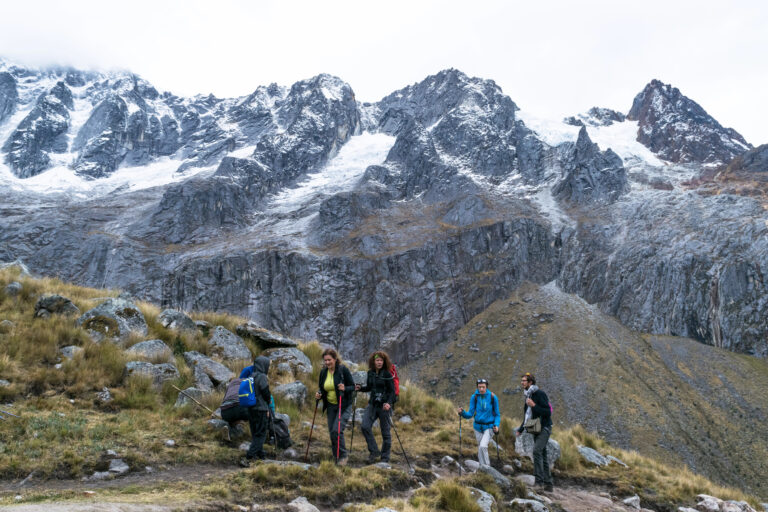 Landscape of Punta Union Trek within the Huascaran National Park (Peruphotoart/DepositPhotos)
The second rationale is the intangibles. The sensation of being amid icy walls of Andean peaks, knowing that civilisation is days away by donkey is quasi-spiritual.
The descent from 5000m on Day 5 to the oxygen-rich air at 3500m was also wondrous. Being starved of oxygen and finally inhaling it was truly intoxicating. Colours glowed brighter and a wave of euphoria washed over me as I contemplated an actual settlement again after days in the silent valleys.
There is also much more wildlife. I saw condors everyday, to the extent that we scarcely bothered to look up at them by the end. Other curiosities included torrent ducks, which would leap into a fast flowing stream and miraculously appear far upstream in a matter of seconds and the elusive Andean fox.
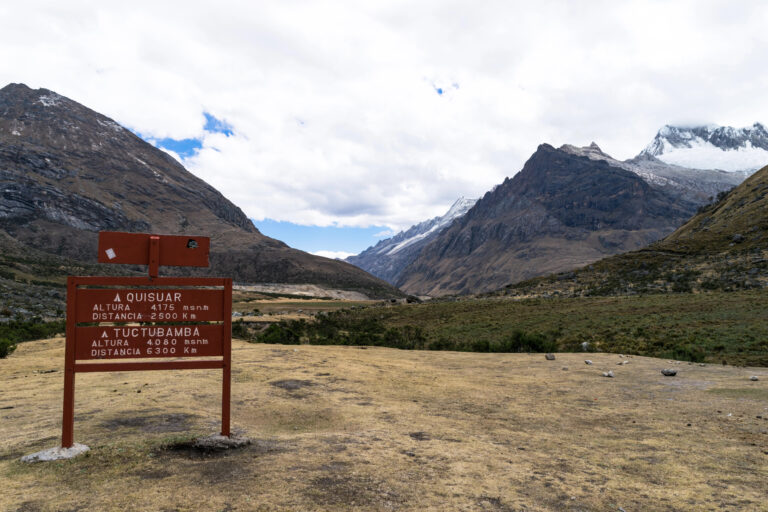 Trail rules at Huascarán National Park — Santa Cruz Trek
As with most things, a compromise is possible. This is the 5 day option of Huayhuash. On Day 5, the route passes through the village of Huayllapa. For those doing the 8 day circuit, this means a warm shower and a proper bed, but for some it can mean a way home. You will walk the first 5 days as in the classic circuit, but you will end the hike 3 days earlier, at a closer outlet to civilisation.
This route has many potential advantages – you will see the two most famous views on the Huayhuash trail, Tres Lagunas and the San Antonio Pass while expending less time and money, not to mention walking less. You also skip Day 6, the hardest day, with a 1200m ascent and the coldest campsite after 5 days of hard walking. The catch is that you will miss Day 7.
Until this day, I actually questioned my decision to do the 8 day route over the 5 day option, as Day 6 had the lowest views to effort ratio, I was tired and cold plus my hamstring was screaming.
All of my whinging and doubt dissipated on Day 7. The panoramic views of glaciated peaks and the iconic Cordillera Blanca mountains like Alpamayo in the distance, with bulbs breaking through virgin snow was simply enrapturing. The day ended beside a shining lake beneath pyramidical peaks with a bucket of beers. I would not have missed this day for anything!
The passes: Every single day, you climb a high pass. The standouts are:
- Las Tres Lagunas — the famous trio of turquoise lakes framed by sheer ice walls
- San Antonio Pass — one of the most dramatic views in the Andes
- Yaucha Pass — the “worth doing the 8-day circuit” moment, 360° of glaciated peaks, including remote Cordillera Blanca spots like Alpamayo
About the trek: You’ll camp at high altitudes, generally around 4,000m or higher, surrounded by icy peaks with very few crowds and villages. Days are long, averaging around 7h of walking, with day 6 being the most challenging – a steep 1,200m ascent to a cold campsite.
The 5-day shortcut option: You can end the trek at Huayllapa on day 5, while still hitting Tres Lagunas and San Antonio Pass. It’s a smart compromise, though you’ll miss day 7, which is the highlight of the entire circuit.
Why I chose each hike
Santa Cruz during my first time in Peru
I first visited Huaraz in July 2023, fresh out of university and 5 months into my backpacking trip. My bank account was running on empty, and I had a flight home in 3 weeks. I absolutely loved the day hikes in Huaraz, and wanted a chance to hike for days through the Andes. Santa Cruz ticked these boxes, allowing me to affordably see those mountain vistas and still get a proper look at Ecuador afterwards.
I still think that even without these time and money pressures, I would have chosen Santa Cruz, as I was not especially experienced at hiking. My only other multi-day hike was the 2 day Colca Canyon Trek in Peru. To go from this to 8 days in the Andes seemed a little extreme. Moreover, I had been recommended this hike more or less from the second I touched down in South America.
I was not disappointed in the slightest. I spent many hours back home daydreaming of the crisp mountain air and razoring peaks. It was my favourite hike ever… until I completed Huayhuash.
Huayhuash on my second time in Peru
By the time I returned to Huaraz in September 2025, my circumstances were much improved than last time. I had a clear run of months in South America ahead, no pesky return flights to contend with, and my finances were healthier too. I also had much more hiking experience under my belt – I had completed the brutal Choquiquiero trek near Cusco and walked a section of the GR20 in Corsica, so I felt ready for Huayhuash.
Although, in all honesty, most of my calculations to do this trek were that I couldn’t get the experiences of Santa Cruz out of my head and was desperate to get back out into the Cordillieras!
Essential things to know from my experience
Tips for Santa Cruz
Day 2 of Santa Cruz is the hardest day with a 900m ascent, but it is absolutely stunning. Probably the best photo ever taken of me was me as a silhouette against the frosty bulk of Taulliraju.
With the exception of the second day, none of the other days are particularly hard if you are acclimatised. The first and last days are only really half days of walking and only have small uphill sections. Day 4 in particular barely merits the name of a hike, it is just a 3 hour downhill walk to the nearest road. So if you feel ready for 2 days of walking uphill, you are ready for Santa Cruz.
I was not told quite how cold it got on the mountainsides at night, and with my inexperience of the Andes, I really struggled on the first night, where the temperature got down to -9 and I did not bring any warm sleeping gear! Bring thermals to avoid a shivering sleep.
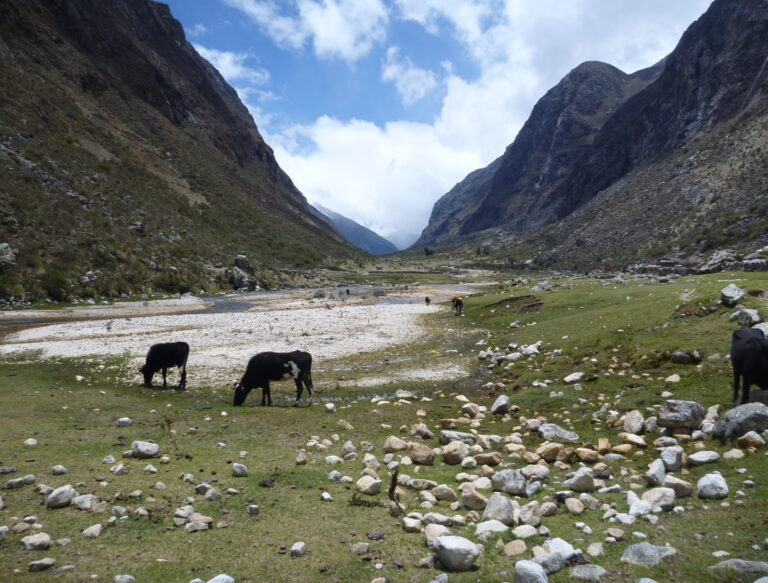
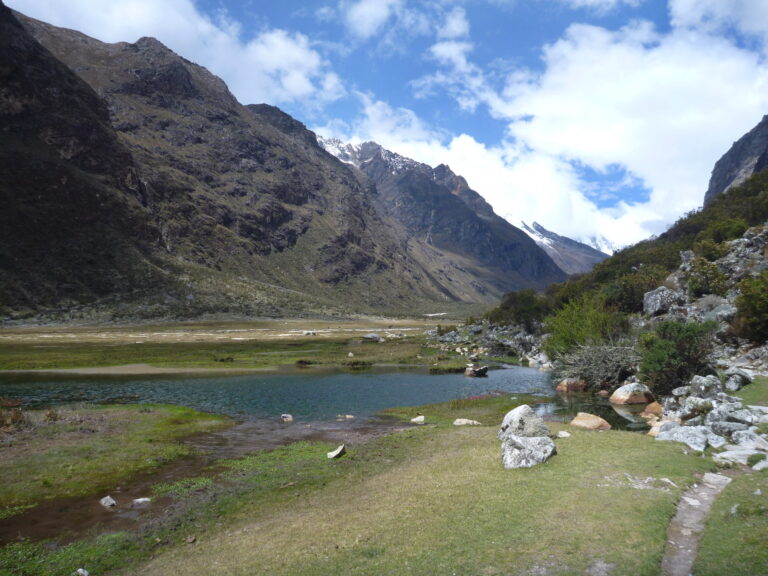
Bring cash. It is the done thing to tip your guide, some tours do not include the 60 soles national park entry fee and there are opportunities to buy drinks or snacks on the trail! Trust me, you will want that beer when you see it on sale.
Take swimming gear. The brave among you may want to dive into Lake Arhuaycocha for a pretty epic photo op amid the glaciers and turquoise water. But for the less crazy, the third campsite has a river which is not cold at all, making for a top shower alternative.
Tips for Huayhuash
While each day of the Huayhuash trek was special, days 3, 5 and 7 of Huayhuash were my standouts. Las Tres Lagunas on Day 3, San Antonio Pass on Day 5 and Day 7 for the mystical experience of waves of mountain peaks spread out before me.
On Day 5 of Huayhuash, you get a welcome respite from life on the trail, with the option of a hostel, a much needed warm shower and chances to buy supplies. Definitely bring cash for this as you will not want to miss out.
Day 6 was absolutely brutal. You wake up in a warm bed at an altitude where the air contains oxygen, but as if for punishment for this comfort, the gods of Huayhuash dictate that you will climb 1200m up steep paths to a campsite at 4500m! Steel yourself for this difficult day.
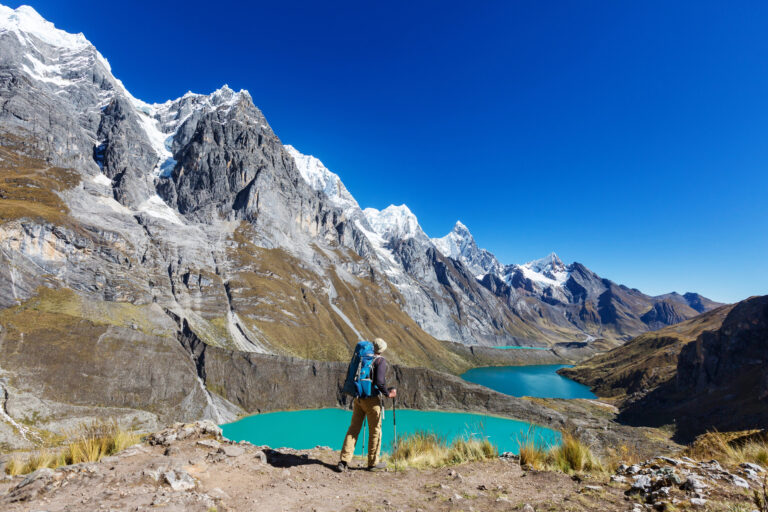 Hiking scene by Las Tres Lagunas
There are some very early starts on this hike. The journey from Huaraz to the trailhead is about 6 hours. While some operators will drive you directly to the first campsite in preparation to walk the next day, most will collect you from your hostel at 3AM. The long distance also means a 4AM start on the final morning. The wake up time for the other days is 6AM with a 7AM start on the trail.
There are lots of opportunities to interact with very isolated Andean communities. Shepherds’ huts are scattered throughout the circuit, allowing you to meet Quechua speakers sticking to ancestral ways of life on one of the most remote parts of the continent. The people in Huayllapa are also very friendly – I played a game of football with them!
Recovery after walking is key to making it around comfortably. Walking for more than a week in the Andes subjects your body to a real pounding. To prevent injury or from walking with the gait of the Tinman, always stretch after you walk or even sit in a glacial stream for an ice bath!
Wet wipes were a real lifesaver, as they were the best shower alternative going. As was toilet roll. There are flushing toilets at each campsite, but never toilet roll.
Bring a book or playing cards. There is a lot of time spent at camp during this trek, and some entertainment goes a long way. Needless to say, there is no WiFi for the duration, except on Day 5 at Huayllapa village.
Please visit:
Our Sponsor