
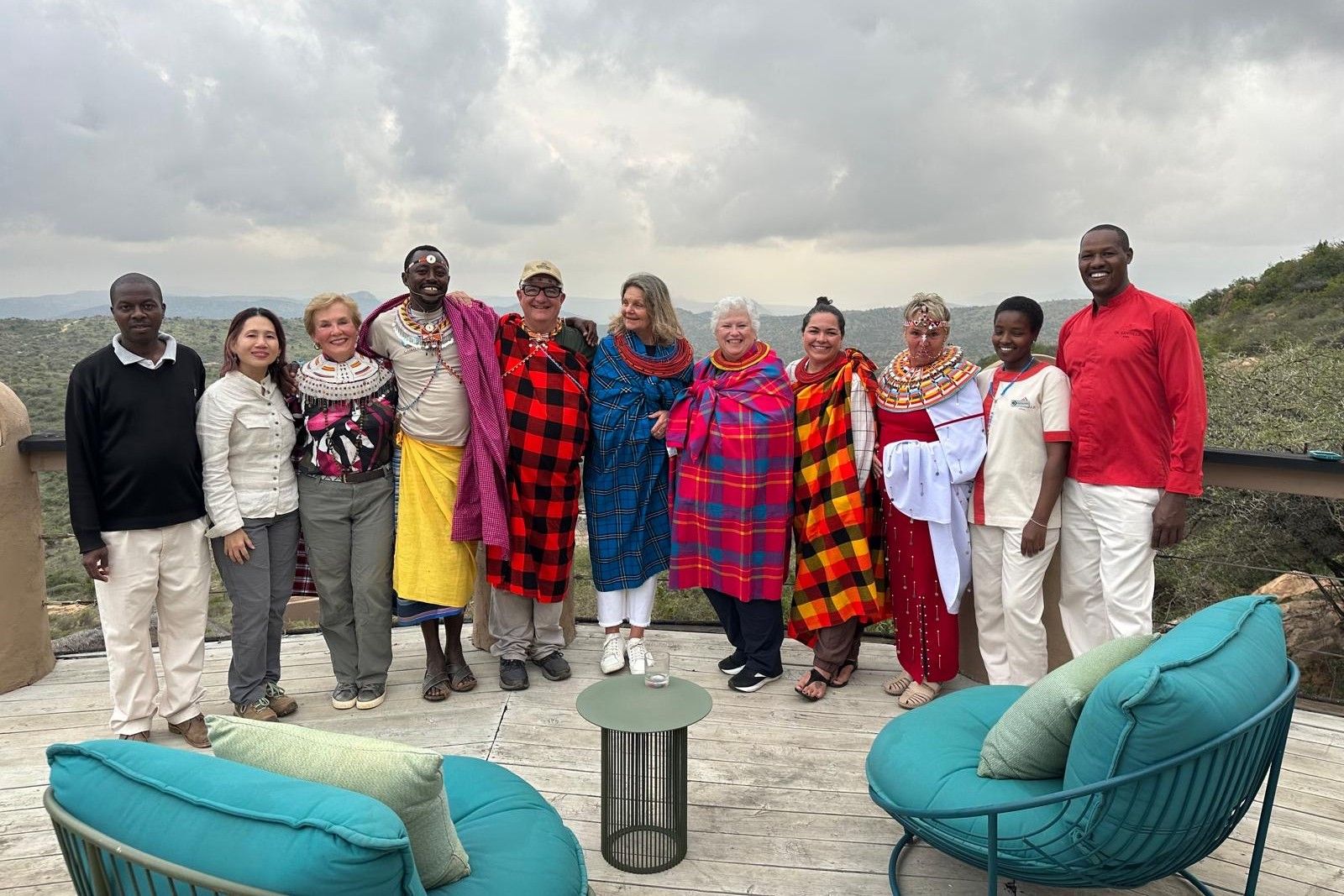

I, along with several other travel professionals, recently had the opportunity to visit Ol Lentille with Andrea Hugo of Andrea Hugo Associates.
Ol Lentille is perhaps the most unique property in Kenya. John and Gill Elias built The Sanctuary at Ol Lentille in 2007 and donated it to the local Maasai community. Andre Cohen and Laura Yung took over as private investors and have been operating the lodge in partnership with the community since 2022. The lodge is situated in a 40,000-acre private conservation area in the far northern escarpment of the Laikipia Plateau. (For perspective, that is about 3 times the size of Manhattan!) Perched at just over 6000 feet above sea level, the lodge offers spectacular 360-degree views of the region.
During my stay, I had the chance to experience several of the activities that make Ol Lentille so special.
Sundowners on Flat Top Rock
My group flew in from the Maasai Mara in a Cessna Skylane chartered from Scenic Air. When we arrived, we were met by lodge staff with two land rovers, and taken to the lodge, an easy 15-minute drive. After a brief tour of the property, we were driven to Flat Top Rock for sundowners. At Ol Lentille, the experience was extra special! Camp staff had gone ahead of us to set up, so we arrived to a lovely fire made in a quirky frog-shaped portable fire pit. We had chairs, blankets, and a variety of food and spirits waiting on us, perfect for warding off the damp chilly air that followed a rainy day!
 Spirits to ward off the chill at the top of Flat Top Rock
  Quirky fire pit
Tura River Interpretive Walk/Singing Wells
We got up early the following morning. After a bumpy 20-minute drive, we arrived at the Tura riverbed. While it is described as a “dry riverbed” this is not entirely accurate. Water here flows in a trickle, adequate to supply the local people, the wildlife, and Ol Lentille as well. The lodge offers a short walk of about 30 minutes, and a long walk of about an hour and a half. My fellow travelers and I opted for the latter.
Our guide, Solomon, who is a Junior Elder in the local Maasai community, led the walk. He is a wealth of knowledge! Solomon took his time educating us about local plants and wildlife, and the importance of the river to the community. We saw some of the “singing wells,” which is a tradition unique to the Maasai and Samburu people in this area. Wells are dug deep into the dry riverbeds. Maasai and Samburu warriors create a human chain that descends into the well, and pass water up to the surface in buckets. The men sing a haunting and beautiful chant, which signals their cows to come and enjoy a drink.
There were a couple of interesting pauses along the way. The first was when we saw a small herd of elephants crossing the riverbed. Or rather, Solomon saw them and alerted us. We gave the pachyderms plenty of space before moving on. We stopped again a little later, and Solomon instructed us in the art of Maasai spear throwing!

We continued until we encountered the Tura Drop, a sheer drop-off with breathtaking views of the valley below. From there, the walk took a more challenging turn as we had to scramble up a somewhat steep rock face to the top, where we were rewarded with a well-earned bush breakfast.
 Arriving at Tura Drop
Maasai Manyatta Visit
A short drive later we found ourselves arriving at a Maasai manyatta. The women and children stopped what they were doing and welcomed us with a bit of traditional song and dance, inviting us to join in. It quickly became apparent that this was not just another contrived tourist performance. Rather, we were being welcomed as honored guests who would get a glimpse into the real day-to-day life of the manyatta. Our little group of six split into two groups of three.
Solomon took a group to visit Mama Vincent (more on that below) and Terry, another guide with Ol Lentille, took us to see some of the women building a new home. The women had dug a 4-inch wide trench a few inches deep, in perhaps a 10-foot square. They sang as they worked, pressing cut branches into the trench and securing them with bits of string, rope, and fabric. This would later serve as the framework for a mix of cow dung, sand, and wood ash that would be the home’s walls. (Wood ash in the mix helps with insect-proofing the new home).
The matriarch, “Mama Vincent” then invited my group into her home, a simple setup with areas for sitting, sleeping, and cooking. Mama Vincent was sanitizing a hollowed-out gourd used for milk storage. After a rinse, she added a bit of water. She then plucked small half-burnt still-glowing pieces of wood from the small fire, dropping them into the gourd. After placing the lid on, she would shake the gourd vigorously, producing steam. She did this repeatedly, until the outside of the gourd felt hot to the touch. Terry acted as translator while we chatted with Mama Vincent about life, children, the manyatta, and other things.
 Mama Vincent and Laura Yung
Quad Biking
After returning to the lodge and eating a delicious lunch by the pool, our group separated. Some simply relaxed for the afternoon. Some opted to learn about Maasai bead work. As for me, I heard the quad bikes calling my name! Terry drove us out to the bikes, and after a quick refresher, we were on our way. The quads were a hit with the local children, who came rushing to the roadside to wave at us as we flew by! This was a brief but very fun excursion.
A Birthday Blessing
After returning from the quad bike excursion, I gathered with my group for drinks at the rooftop bar, which is situated above the gallery. Unfortunately, our happy hour was interrupted by rain, so we were quickly ushered to the Boschia villa to dry off. As we sipped our drinks, Solomon appeared and announced that we had a special occasion to celebrate. Today was the birthday of Lori, one of my traveling companions. Solomon explained that, while the Maasai do not really celebrate birthdays, he had arranged for several local elders to come by and offer a blessing! This would be a sacred experience, and Solomon instructed us in the words and gestures of how to properly receive the blessing. Each elder, in turn, chanted in the Maasai language. Afterwards, Solomon translated what was said.
 Solomon (left) with Maasai Elders
Boma Dinner and Maasai Dancing
The rain had let up a bit, and my group was given umbrellas and ushered into Ol Lentille’s Boma. Dinner was supposed to have been served here, but would be moved to Boschia instead, so we were not sure what to expect next. We did not have to wait long to find out. Night had fallen, and a roaring campfire had been lit in the middle of the boma. Before long, the darkness was pierced by the sound of Maasai singing as they danced in a line into the boma. They circled the fire several times, pulling each of us in to join. After a while, the women and young men, or warriors, separated. We watched, spellbound, as the warriors took turns jumping impossibly high in groups of two or three around the fire. Solomon explained that the warriors were showing off their strength to the women. He also noted that this was a favorite activity of the warriors and women, and that this would continue back at the manyatta long after our demonstration was completed. With that, he took my hand and said “We are elders; let me show you how the elders join in. We don’t jump as high as the warriors.” I happily joined in for a turn around the fire with him!
Climb to Ol Lentille Peak
The following morning, our group woke early and climbed to the top of Ol Lentille Peak. I opted not to join in, as the previous day’s walking and dancing had gotten the best of me, but as you can see, the views are stunning!
 My fellow travelers at the top of Ol Lentille peak
  Sunrise from the top of Ol Lentille peak
Ol Lentille stands apart not only for its breathtaking setting but also for the authenticity of every interaction. Each activity, from walking with Maasai guides to sharing moments with local communities, reveals something new about this remarkable corner of Kenya. For travelers seeking experiences shaped by culture and adventure, Ol Lentille is an exceptional place to include on a Kenya itinerary.
Please visit:
Our Sponsor