
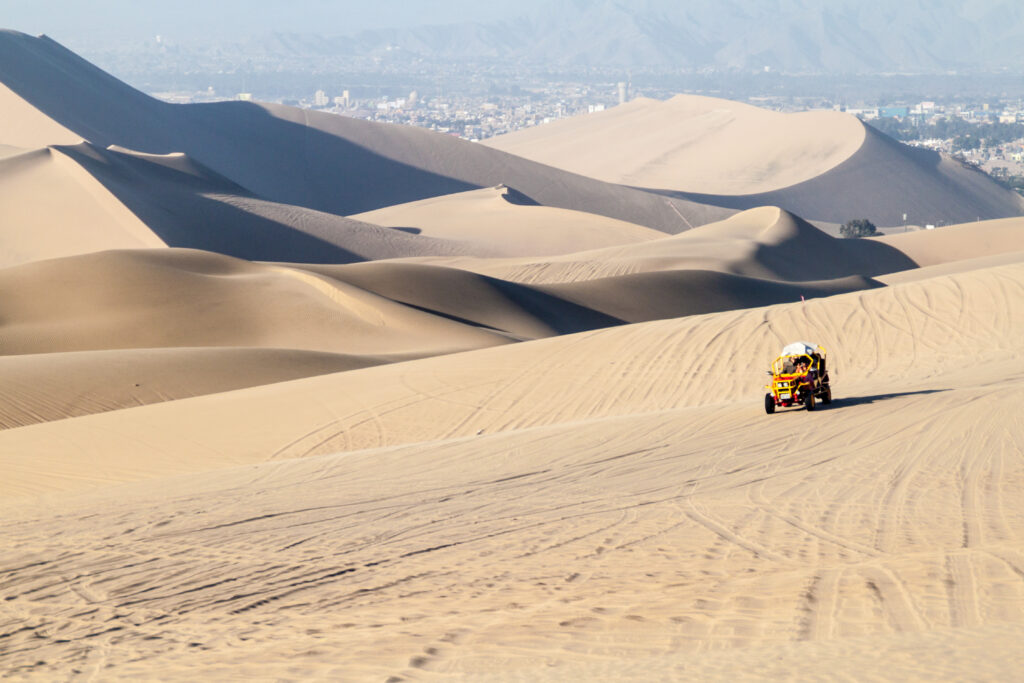

Rather than rushing straight from Lima to Cusco or Arequipa, as some tourists do, why not explore the beguiling desert region on the capital’s doorstep?
Of all my four months in Peru, one thing that really stuck with me was a sunset over the Huacachina oasis. This is not just because the iridescent purple glow over an ocean of sand dunes was such that I could not suppress a cry of wonder.
That morning I flew over the Nazca Lines, just a few hours away, enabling me to sit on that sand dune, beer in hand contemplating ancient mysteries with a day of sand boarding and dune buggy rides ahead of me. The following day I would travel just a couple of hours to gawp at penguins and sea lions at Paracas. I struggle to think of another place on Earth with a combination of attractions like this.
If you are in a rush, you can visit all the heavy hitters in a day or two, but there is enough here for a week of enrapturing sightseeing.

Why visit the Peruvian desert
It is quite a common saying that there are three Perus: the sierra, the jungle and the desert.
If you are visiting Peru, you will most likely visit Machu Picchu and Cusco, so that is the sierra ticked off. Likewise, jungle tours are very accessible and popular.
Visiting all three allows one to truly experience the mind-boggling diversity of Peru’s landscapes. It is as if bits of Morocco, Nepal and Brazil were sewn into one country. Do not miss what makes Peru so special! The desert is on the doorstep of Lima and is on the way to Gringo Trail favourites like Arequipa and Cusco.
The other compelling aspect of a visit to the desert is that there is LOADS to do. The sand dunes do not just sit there — they become sand-ski runs, dune buggy racetracks or perches for a desert sunset. Throw in spades of Nazca history and the bays of Paracas, where the desert meets the Pacific, and there is something for everyone.
The real question is why you wouldn’t go!
(Later I’ll explain how to easily get here from Lima, Cusco, or Arequipa.)
How to explore the desert region
There are essentially two ways of experiencing the desert:
- You can base yourself in just one of the towns (Huacachina is most suitable geographically) and take day trips to each attraction.
- Or, you can stay in all the towns, one by one, and experience the attractions around you.
I wouldn’t say that there is a right or wrong way to do it, it depends a lot on your travel style and how much time you have.
The beauty of basing yourself in one place (like Huacachina) and taking day trips is that you can pick and choose which sites you see. For instance, you could be fascinated by the riches of marine life on the Ballestas Islands and long to see the Nazca Lines, but be pretty indifferent to seeing the rest of Paracas’ coastline or the other Nazca sites.
With this approach, you can tailor your plans without being locked into spending excess holiday time, not to mention doing away with the faff of packing and taking buses to each place. You can see the highlights conveniently and then go on your way to Cusco or Arequipa.
An oasis within the oasis, and they include a free activity each day in the price
Offers a year-round outdoor swimming pool, a lush garden, and a nice terrace
Feels like a real desert oasis with a tropical outdoor space, modern bar, and friendly service
 (Anna-ch/DepositPhotos)
The second approach, which is the one I took, is to weave your way through the towns. I found this an immersive experience, where I felt each place profoundly and it allowed for local knowledge and spontaneity to have a hand in my travels.
I planned to spend a day or two in Nazca, but ended up staying for a week seeing archeological sites I’d never heard of and doing sunset yoga in the desert with new friends. I loved this approach, but I did have the privilege of 6 months to roam around Peru!
Suggested itinerary with Huacachina as a base
Weeklong itinerary for travelling through the region
- 2 days in Paracas – Visit the Paracas Reserve and the Ballestas Islands at leisure, with lots of time for sunbathing and swimming in the Pacific.
- 2 days in Huacachina – Ride in a buggy and shred the dunes, with enough time for a lazy hangover day after partying hard.
- 3 days in Nazca – Build up to the main event of seeing the Nazca Lines by visiting the town’s fantastic museums and archaeological sites like the Cantalloc Aqueducts. On the third day, fly over the Nazca Lines with the luxury of historical context. Easy onward travel to the South of Peru.
What is there to see
First let me tell you about all the top things to do in each place, before explaining how you can connect each of these into an action-packed travel route through Peru.
Besides the highlights I’ll also cover some additional sights and experiences if you have some extra time available. Read along to find out why Nazca was actually the biggest surprise of my trip!
Paracas
Paracas Reserve — this was my favourite place that I visited in Paracas, and I really think that it is a standout attraction in Peru. Here, the rolling dunes of the desert meet the Pacific Ocean. Soaring cliffs, beaches formed by volcanic activities and lagoons full of flamingos make the reserve a wellspring of wonder.
 Paracas National Reserve blends desert and ocean landscapes with ancient Paracas culture ruins (IuliiaSerova/iStock)
The reserve is a large expanse but I had two favourite attractions. First is Playa Roja, a scarlet beach born of volcanic activity. With the sandy nothingness of the desert behind you and vultures overhead, this is an amazingly ambient place that lingers in the memory.
My other pick is La Catedral. This is a huge sea stack that once had a perfect outline of a cathedral, but after an earthquake, it now has a great triangular form, almost like a shark’s tooth. Watching the deep blue waves of the heaving Pacific crash against it is hypnotic.
There are three ways to experience the reserve.
- The first is simple, a minibus tour that will drive you around the reserve, and stop at a handful of viewpoints. It is a cheap (40 soles) way to see the main sights, and is accessible for all.
- The second is a variation of the first, but in a much cooler form of transport – a dune buggy. With the wind in your hair and the lurching of the vehicle over sand dunes makes this an incredible way to see the reserve. Some operators also offer buggy tours for golden hour, and it is possible to book buggies for 2 people or ones with a greater capacity. The catch is that it is the most expensive option — especially if you opt for a smaller buggy.
- The third option is the cheapest, to cycle. I found it more fun than the minibus. You can rent a bike from a series of vendors in the town centre. I rented mine from a guy who also owned a burger van that I frequented. I paid 25 soles for the day, and he even offered his 15 year old daughter in marriage to me as part of the deal. I politely declined. The ride is quite intense, as the cycle route is 30km, and you will be buffeted by strong winds. It was hard work, but I found being able to do the reserve at my own pace a very liberating experience.
Map out a 2-week itinerary in Peru

If you have at least 2 weeks in Peru, you can plan an epic, action-packed trip to this Andean nation. Whether you want to trek through the Andes, explore ancient ruins, or immerse yourself in local culture, Peru has something for everyone.
You just have to decide what your budget is and what experiences matter most to you and this 2-week itinerary will map it up for you.
1. Cruise to the Ballestas Islands
These are affectionately known as the ‘poor man’s Galapagos’. As the Galápagos Islands are out of the price range for many people, these are the next best thing to do while backpacking South America.
 Ballestas Islands, Paracas National Reserve
Boat tours leave twice daily from Paracas, the trip is 45 minutes to the islands. These were once a gold mine for guano, a natural fertiliser made of bird droppings, that drew hordes of European prospectors to seek their fortunes here. Now, the only inhabitants are colonies of sea lions, pelicans and penguins.
You don’t actually set foot on the islands, but just observe the animals from your boat. The sea lions were particularly memorable as they adorably sunbathe or spar while letting out hilarious cries. I even saw a pod of dolphins leap out of the ocean on my excursion! I paid 80 soles for my tour, and it took about three hours in total.
2. Explore the ruins of Tambo Colorado
Do not despair, history buffs, there is more than just sand and sea in Paracas.
The Incas were once here, which is interesting in and of itself as their heartland is hundreds miles away in the mountains — but this is a unique ruin, as they adapted their buildings to local materials.
When you walk around Tambo Colorado, it is recognisably an Inca building — trapezoid doorways, distinctive altar platforms and niches on the walls, but it is made of golden adobe. It is like one of the variations of Storm Troopers in Star Wars, unique and limited editions of the original.
3. Visit Museo de Sitio Julio Tello
This beautifully designed museum is a brilliant glimpse into the peoples who inhabited this land 3000 years ago.
Their world was weird and wonderful; they bound their heads to give them an oblong shape, and they wove beautiful textiles which have been perfectly preserved by the desert. They even pioneered the idea of drawing glyphs in the sand before the Nazca culture did.
4. Hike out to Laguna Moron
Yes, Huacachina is the most famous oasis in South America, but that doesn’t mean that you should dismiss this brilliantly-named gem. Laguna Moron is smaller than Huacachina, but you get to experience it without crowds or a ring of buildings around it. You can even paddle in it.
Be warned though, the water is freezing cold. I got a shock jumping in! Located just an hour away from Paracas, I found it a wonderful way to spend an afternoon.
Huacachina
This desert oasis is one of the star attractions in Peru, and for good reason. I had never seen an oasis before coming here, and I could never get over the green water impossibly existing among the walls of sand. That is before you even factor in the activities on offer here and its pumping nightlife.
 Huacachina oasis in the Ica Region, Peru (saiko3p/iStock)
1. Sand boarding
There are levels to this sand sport. You will see people gracefully skiing down the sand dunes or standing up while bombing down on a snowboard. You will most likely start lying down and take lots of tumbles. This is part of the fun.
I was surprised by the speeds you hit and the thrill of falling head first into the sand. The dunes in Huacachina are so big that you can speed down for up to a minute. Tours often combine a dune buggy ride over the dunes which can pick you up from the bottom of the dune to ensure more fun and less exhausting walking.
2. Dune buggy tours
Riding on a dune buggy is just unambiguously cool. How low you are to the ground, bounding over the dunes and the wind in your hair makes it feel as if gravity has lapsed!
There are many options for dune buggy tours at Huacachina. Some will combine sandboarding and a drive out into the desert for sunset. Others will just offer you the thrill of cruising through the dunes. There are no bad options; just make sure that you bring a bandana or you will end up swallowing a sandcastle’s worth of sand, as I unfortunately discovered.
 Tip: Visit at sunset for the best light and incredible views of the oasis below (YaseminOlgunozBerber/DepositPhotos)
3. Climbing the dunes
The cheapest and most accessible activity in Huacachina. Just walk in any direction from the town and walk straight up. You will get a fantastic vista over the oasis, which seems genuinely miraculous against the barren ocean of rolling dunes.
The best time to do so is at sunset. Buy a tin of beer and sit and watch as the sun signs off in waves of indigo and burning orange. It is like a scene from the Arabian nights with the silhouetted waves of sand dunes and the lights of Ica in the distance. Stay after dark for incredible star gazing. Do bring layers as it gets chilly at night here.
4. Paragliding
I personally did not have the head for heights needed for this, but for adrenaline junkies, there are plenty of chances to see the oasis from above and see the extent of the desert. Expect to pay about $100 for a flight.
Huacachina’s nightlife
Although Huacachina is essentially a village in the desert, it punches well above its weight in terms of parties. It packs a Wild Rover, a chain of hostels known for its raucous nightlife and drinking games, as well as lively nights at Viajero and Banana’s Adventure. I can’t think of anywhere else where you can have pre-drinks on a sand dune looking at the setting sun before dancing the night away.
For those who would like to dip into the nightlife without committing to pumping music late into the night, you can enter the party hostels as a guest.
Nazca
I honestly did not expect much when I visited Nazca. I thought it would be a dusty village next to an airstrip, a place from which to see the Lines and then leave. I was very mistaken. Not only was the town charming, packed with great coffee, it also had a wealth of cultural attractions that kept me for days.
The living was so cheap and the climate so fantastic that I stayed there as a digital nomad for a spell! I made friends with some Argentine hippies driving up South America, and we would drive out to the desert every night for yoga and stargazing. It was the biggest surprise of my trip to Peru.
 Figures in the desert of Palpa, Nazca (Peru)
1. Fly over to the Nazca Lines
These are quite possibly the biggest archeological mystery ever.
While some will claim that aliens created them, the leading theories explain them as pleas for water to their flying god, paths for ritual processions or a great cosmic calendar — though no one knows for sure. What is for certain is that there is nothing like it in the world. There are plenty of options to observe them for different budgets.
I personally opted for the flight. This set me back $85 including taxes. I would have paid nearly that amount for the flight alone — I was in a 6-seater propeller plane, which banked and twisted through the air, an incredible thrill. That is before you even get to the Lines — their size and how flawlessly geometric they were took my breath away.
Editor’s note: Pre-booking online will cost a little more, but it’s the safer bet for a tightly planned itinerary. More flexible slow-travellers could consider booking last-minute locally.
Book Your Nazca Lines Flight (€107)  (iStock/Flavio Ricci)
They are a work of art as much as an archeological site, and from the plane, you can appreciate the scale of the lines and how many are interconnected. Some flights go for as long as 2 hours to include the recently discovered Palpa Lines.
The other options are to view the lines from an observation tower on the side of the Panamericana Highway or a natural viewpoint close by. From here, you can see the parrot and the lizard, which sadly got split in half by the highway.
The pros of this are that it is much cheaper than a flight. You can get a bus from the town to the tower for 6 soles ($1) from the Peru Bus terminal. It is also a more faithful view that the Nazca themselves would have had. However, you can only see two lines from here.
2. Explore the Cahuachi pyramid
Egypt is not the only desert with pyramids. This was once the ceremonial centre for the Nazca civilisation, who would perform rites with hallucinogenic drugs and even perform human sacrifice here.
Only found in the 1980s, this sprawling adobe complex is very impressive and I found that the sections still yet to be uncovered added an air of mystery to it. If you have seen the Nazca Lines, I would advise on leaning into your sense of wonder at seeing such a mystery and explore lesser known archeological sites like this.
3. Walk the Cantalloc Aqueducts
Visiting the aqueducts is a lovely way to pass a couple of hours. They are located a thirty-minute walk from town, and require a 10 soles entry fee. The aqueducts are an intriguing spiral shape, almost like a staircase winding into the earth. There is a seemingly miraculous pool of water, often with fishes in at their base. These great engineering achievements were once the difference between life and death in the desert.
 Cantalloc Aqueduct in Nazca or Nazca town, spiral or circle aqueducts or wells, Peru, Inca architecture and culture (DanielPrudek/iStock)
4. See ancient mummies at Chauchilla Cemetery
I have honestly never been anywhere quite like this before. These cemeteries are where the Nazca entombed their dead. Though grave robbers got there first and took the gold, owing to the aridity of the desert, everything has been more or less the same for the last 1500 years. Mummies sit in open air pits with intact hair and finger nails.
Most striking for me was the chance to walk around the cemeteries, an expanse of sand strewn with human bones, textiles and shards of pottery. I picked up what I thought was a shard of ceramic, but it was part of a skull with hair attached! This place will certainly stick in your memory.
5. Museo Maria Reiche & Museo Antonini
For such a small place, Nazca has spades of culture. Museo Maria Reiche is located about half an hour out of town, accessible via the Peru Bus terminal or a taxi. I would combine a visit with a trip up the nearby observation tower.
Half of Nazca is named after Maria Reiche, who devoted her life to uncovering and conserving the lines, as well as arguing that they were based on astronomical alignments. This museum preserves her frugal house out in the desert almost exactly as she left it, with drawings of the Lines with constellations overlaid. It also includes a selection of a Nazca ceramics and a mummy,
Museo Antonini is located in Nazca town and houses a much larger collection of Nazca artefacts. Its signage is detailed, and I would recommend going before visiting the lines to get some context for the marvel you will witness. Particularly striking were the skulls with holes in their foreheads for a rope to be inserted through so that they can be displayed like bunting. They were most likely victims of human sacrifice.
6. Stargaze at the Planetario Maria Reiche
This little gem holds nightly lectures on the Nazca Lines combined with some guided star gazing. Looking up at the heavens projected onto the curved roof of the planetarium, with the lines mapped onto them, as a honeyed voice explained the theories for their construction felt almost spiritual. Shows are an hour long and held in English, French and Spanish.
7. Climb Cerró Blanco
This monster dune is around 3,860 feet (1,176 meters) from base to peak, and it’s one of the highest dunes in the world.
To summit it will take about three hours and it is an achievement to boast about for the future! The way down is definitely easier than the ascent – most tours offer the chance to sand board down this sandy behemoth.
 Cerro Blanco, one of the highest dunes on the world
7. Visit Reserva San Fernando
Ever wondered how it would look if the sea met the Andes? San Fernando is your chance. The reserve is home to marine life like penguins, sea lions and sea otters but also Andean species like guanaco and condors. The landscape is breathtaking – the coastline is all arches and dramatic crags as the spurs of the Andes fall into the Pacific. It is also very accessible from Nazca, and available as a day trip.
Pisco
This little port town gives its name to Peru’s iconic spirit, a wine brandy created from the grapes of the desert. Peru’s national drink, the Pisco Sour, is made by mixing Pisco with lime juice and egg whites.
To make it yourself here in view of rolling vineyards in the desert is like drinking the landscape. It also contains South America’s oldest wineries, as the homesick Spaniards planted vines here in search of some liquid home comforts.
 The traditional pisco jars – commonly used in vineyards across the Ica region of Peru
I visited Tambo de Tacama which is closer to Ica than Pisco, but it had a great English language tour and tasting. It also had the original 17th century distilling equipment on show. It is about an hour from Paracas and half an hour from Huacachina. Some tours stop at multiple wineries if you fancy getting wavey!
Getting to the desert
For many travellers, the journey will begin in Lima, the international gateway to Peru. Some love it, others hate it. After making up your own mind, you can very easily make the hop to each of the desert destinations.
From Lima there are various direct connections. Coach buses leave from Lima’s Southern bus terminal, Javier Prado, which is a 45-minute Uber ride from the popular Lima districts. The journey from Lima to Paracas is 4 hours 30 minutes, Lima to Ica (the stop for Huacachina) is 4 hours and Lima to Nazca is 8 hours.
The desert is also accessible — though it will be by way of a night bus — for those working their way North from the South of Peru or Bolivia. You will most likely come via the cities of Cusco or Arequipa.
From Cusco take the 17 hour bus to Ica, where you will need to change buses. From Ica it is one hour to Paracas, or you can take a 20-minute taxi to the oasis of Huacachina. There is also a direct bus from Cusco to Nazca, which takes 14 hours and 30 minutes.
From Arequipa, the journeys are a little less punishing. It is 12 hours and 30 minutes from Arequipa to Ica, from where it is a 20 minute taxi to Huacachina, or an hour further on a bus to Paracas. To reach Nazca from Arequipa, it is a 10 hour direct journey North.
Please visit:
Our Sponsor