
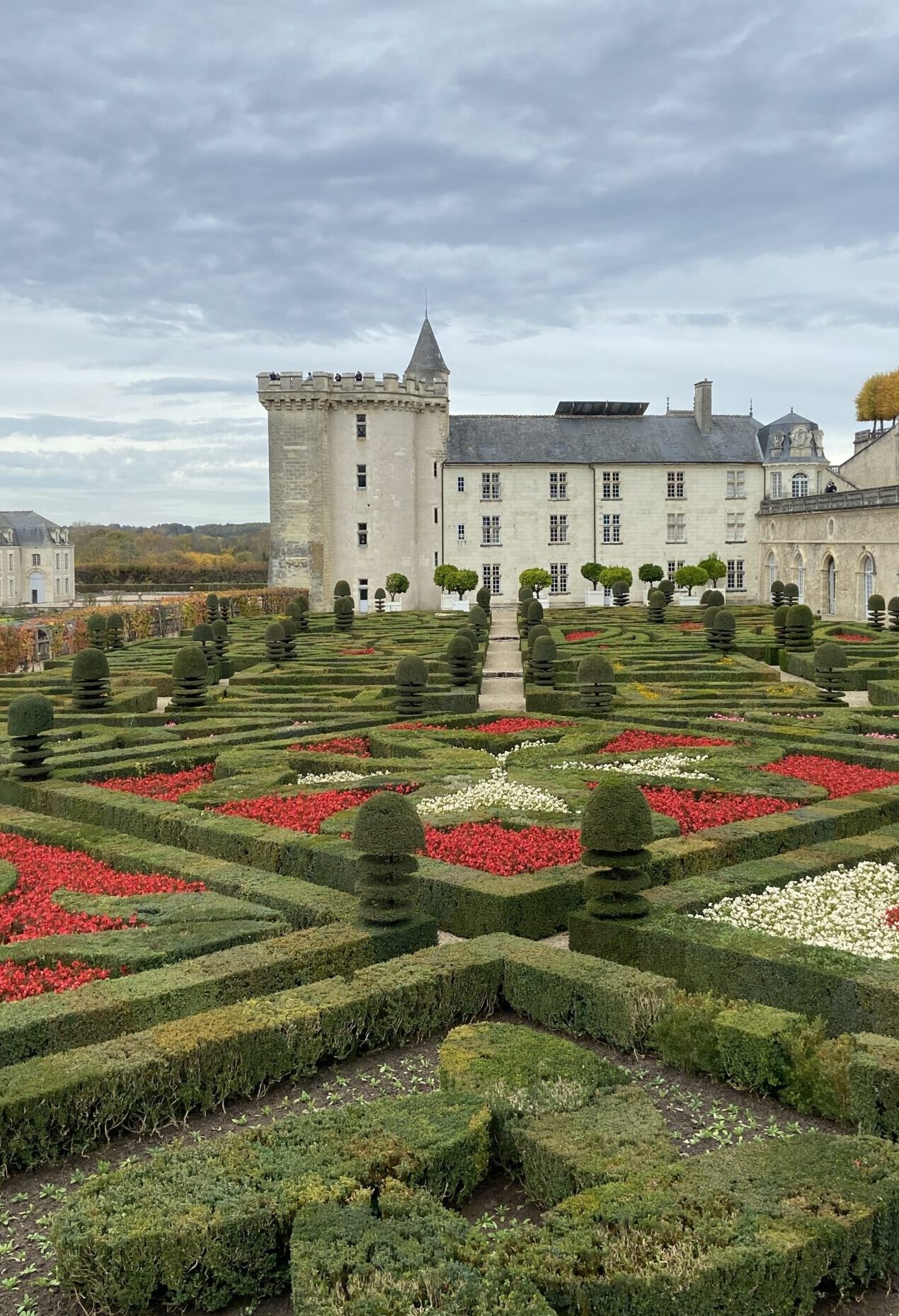

Chateau de Villandry was the final Loire Valley castle we visited during our time living in France. So with its medieval history and epic gardens, did we save the best chateau for last?
Well, it depends what you’re visiting for!
When we first entered Chateau de Villandry, I will admit that I wasn’t too impressed. The castle complex looked small and underwhelming.
But when I exited the castle and looked out over the gardens for the first time, I was singing a different tune. I understood why people loved Chateau de Villandry!
Below I’m going to walk you through each part of the chateau and let you know whether they’re worth visiting. Of course, this is all based on my own experience and opinions – your mileage may vary.
But even if we have differing opinions, my guide below will help you get a better understanding of Chateau de Villandry and figure out whether or not you should add it to your Loire Valley bucket list.

What you need to know before visiting Chateau de Villandry
Opening days & hours
- The garden is open every day year-round, except Dec 25
- The castle closes for a few weeks in January and November each year
- Opening hours are between 9/9:30am to 5-7pm, depending on the time of year
Prices
- Adult fare for the gardens and chateau is €14 ($16 USD), or €8.50 ($10 USD) for just the gardens
- Youth and students pay €8 ($9 USD) for the gardens and chateau, or €5.50 ($6 USD) for just the gardens
- Children under age 8 can enter for free
- There’s an audioguide available for an additional €4 ($5 USD) per guide
Parking
- Free parking is available across the street from Chateau Villandry
- There are spots for cars, buses, camper vans and bicycles
- We also learned that there’s electric car charging stations at the tourist office, which is just down the road (walking distance from the castle)


Visiting the castle with a baby
Visiting the castle with a dog
- Leashed dogs are allowed in the gardens
- Small dogs in carriers are allowed inside the castle
- As you can see from the photo above, we brought our dog, Ellie!
Get the most up to date info on the chateau’s website here.


A brief history of Villandry Castle
The earliest fortress built on what is now Villandry Chateau dates back to the 12th Century. You can still see the original keep at the chateau today. At that time, the castle was known as Colombiers and was where the Peace of Colombiers was signed.
In 1532, Jean Breton purchased the land, razed the medieval fortress, built the chateau, and added the south and west gardens. He opted for a more simple French style, rather than the ornate Italian Renaissance style you see in some other chateaux.
In 1754, the property was purchased by Marquis Michel-Ange de Castellane. He redesigned the interiors, constructed outbuildings and expanded the gardens.

The chateau continued to change hands; at one point it was owned by Jerome Bonaparte (Napoleon Bonaparte’s brother) and at another, by Pierre Laurent Hainguerlot, who redesigned the gardens in the 19th Century.
Finally, Chateau de Villandry was purchased in 1906 by Joachim Carvallo and Ann Coleman. They worked to restore the castle and gardens so they would resemble their original 16th Century style. Their great grandson is the current custodian of the estate.
Now that you know a bit more about the chateau, let’s decide whether it’s worth visiting or not.
Not worth visiting: Ground floor of the castle
 The study
If I’m honest, the ground floor of Chateau de Villandry was underwhelming. After seeing some pretty impressive castle interiors, like at Chateau de Cheverny, I was expecting the same from Villandry and it didn’t deliver.
We learned that the chateau was designed in a more simple French style rather than the ornate Italian style we had seen at other chateaux, like Chateau de Chambord. Which probably explains the underwhelm!
On the ground floor you’ll find a model of the chateau, the drawing room, the study, the dining room, the kitchen and the staircase leading to the upper floors.
Because they weren’t as elaborately decorated, the rooms felt more casual and lived in. You were able to go right up to the furniture and walk through the rooms, as opposed to some other castles where the furniture displays are roped off.
 The drawing room
  The dining room
Despite the more simple look, there are some important historic elements on the ground floor.
The drawing room has 18th Century furniture with silk upholstery from a factory in nearby Tours that is still in operation today. And the Peace of Colombiers was signed in the study.
The dining room was where the two sons of Joachim Carvallo (the chateau owner at the time) were arrested in 1943 on suspicion that they were part of the French Resistance. One son, Edouard, actually was a Resistance leader and would sadly later be killed by the Nazis.
 The kitchen
My favourite room on this floor was probably the kitchen with its stone walls, exposed beams and terracotta tiles. Kitchens in castles always fascinate me!
Maybe worth visiting: First floor bedrooms, library and art gallery
 The moat bedroom
From the ground floor, you’ll move up to the first floor (or what we’d call the second floor in North America) where you’ll find bedrooms and an art gallery with views over the gardens.
Overall, I found this floor more impressive than the ground floor. The decor seemed to be stepped up a notch, though some of the rooms were still quite sparse, and the garden views were nice.
The art gallery was a unique feature (though we did also see one at Chateau Royal de Blois). And Chateau de Beaugency was entirely an art gallery!
 Prince Jerome’s bedroom
  Tower bedroom bathroom
You’ll see four bedrooms on this level: Prince Jerome’s bedroom (the younger brother of Napoleon Bonaparte), the tower bedroom (with a 20th Century bathroom), the kitchen garden bedroom (with the best views over the garden), and the moat bedroom (with family photos and furniture that belonged to owner Ann Coleman).
There’s also a library on this floor, filled with books and items that belong to Joachim Carvallo and Ann Coleman (who bought the chateau in 1906).
On the other side of the first floor lies the painting gallery and Oriental drawing room. Carvallo and Coleman were big art collectors, so these rooms hold a lot of the Spanish realist pieces they admired.
 The painting gallery
  Ceiling inside the Oriental drawing room
The Oriental drawing room was my favourite room as its ceiling is stunning. The ceiling comes from a 15th Century Spanish palace that was dismantled in 1905. It arrived in France as 3,600 pieces of wood and took over a year to re-assemble!
Worth visiting: Second floor bedrooms & castle keep
 Francis I Bedroom
As we keep going up, Chateau de Villandry keeps getting more impressive! My favourite floor inside the castle was definitely the top floor.
Up here you’ll find the children’s bedrooms, the medieval keep and a more modern art exhibition.


PS: Check out Colin holding Ellie in her carrier in the photo above!
It was very cute to see the children’s bedrooms all dressed up with old-timey toys and mini furniture. The rooms also had beautiful views over the gardens.
On the way up the keep, you’ll pass the Francis I Room, which is decorated to show what the bedroom would’ve looked like when King Francis I visited in 1543.
 The rooftop keep
  View from the terrace keep
Continuing up the rickety spiral staircase led to my favourite part, stunning rooftop views from the terrace keep! It was cool to remember the keep also dates back to the 12th Century.
Lastly, there was the exhibition room that hosts different artists whose work must relate to nature or gardens, since that’s what Villandry Castle is all about.
 Exhibition room
I really liked the paintings on display during our visit and the cool room they were displayed in with tile floors and wooden ceiling beams. I’m no artist, but I could definitely see being inspired to paint in a sunny castle attic with garden views out every window!
Definitely worth visiting: Chateau de Villandry garden
 Love Garden
If you only visit one place at the castle, it should be the Chateau de Villandry gardens. These gardens are the reason why this chateau is so famous and they are absolutely the highlight of any visit.
The Villandry gardens are designed in the Renaissance style, meaning they are meant to be viewed from above.


That’s why seeing them from the upper floors and terrace of the castle is so impressive. Only with a bird’s eye view can you see the design and patterns of each garden plot.
There are 7 hectares of gardens which require a team of 10 full time gardeners to maintain them. Four of those gardeners spend three months just pruning the 1000+ lime trees each winter!
115,000 flowers and vegetables are planted every year, with 50% of those being prepared in the greenhouses on site. In the middle of the terraced gardens, there’s a stream, which makes for ideal growing conditions.
 Ornamental Kitchen Garden
  Water Garden
There are quite a few different points of interest in the Villandry gardens, including:
- The Music Garden, with music notes and chandeliers
- The forest, full of flowered terraces and beehives
- The 18th Century Pavillon de l’Audience and 19th Century greenhouse
- The Water Garden, surrounded by lime trees and restored in the 20th Century
- A Renaissance maze with a central viewpoint in the middle
- The Herb Garden, used in the Middle Ages to grow medicinal plants
- The Ornamental Kitchen Garden, filled with colourful vegetables and dating back to the 16th Century
- And a children’s playground!

Colin, Baby C, Ellie and I all enjoyed walking around the gardens and taking in the stunning scenery. We ran out of time to explore it all, but still got to see a lot!
I’d highly recommend devoting most of your visit at Chateau de Villandry – if not your entire visit – to the gardens. Give yourself time to admire the garden plots from above and to walk between them.
Worth visiting (if you’re hungry): Chateau de Villandry restaurant

If you’re hungry, stop for a bite to eat at La Doulce Terrasse, Chateau Villandry’s on-site restaurant.
The restaurant is actually just before you officially enter the castle, but your castle ticket allows multiple entries on the same day, so you can come out for a lunch break.
The restaurant is only open seasonally (April to November) from 10am to 5pm. There’s a covered area, as well as some picnic tables. We had no problem finding a seat and having our dog with us during the meal.
We had a late lunch here on our way out of the castle and thought it was pretty good. Service was fast and the menu was decently priced. I enjoyed my salmon quiche and Colin liked his burger.
 How good do these ice cream flavours sound?
They also had an extensive ice cream list full of cool flavours that use herbs, flowers and vegetables from the Chateau de Villandry garden. Unfortunately, we were too full from lunch to get ice cream, but I wish we had gotten to try it.
So, would I recommend a visit to Chateau de la Loire Villandry?

It depends! If you’re really into gardens and the weather is looking good, I would recommend visiting Chateau de Villandry.
You could even save some money and only buy entrance to the gardens instead of buying the combo castle + gardens ticket. Honestly, I wish we had done that.
But if the weather is bad or you don’t really care about gardens, I wouldn’t go out of your way to visit Chateau Villandry. There were many other Loire Valley castles I liked more than this one.
That being said, I don’t regret visiting Chateau de Villandry. We still had a nice time and it was a convenient stop on our way from Orleans to Normandy. It just wasn’t my favourite castle we visited.
For my favourite Loire Valley castles, check out my guide to Chateau de Chenonceau and Chateau de Meung sur Loire.
And let me know: Would you want to visit Villandry Castle? Or what other chateaux should I put on my French bucket list for our next visit?
Check out the rest of my Loire Valley, France posts to plan your trip:
Please visit:
Our Sponsor